
The Musculoskeletal Biomechanics Laboratory
Principal Investigator: Jennifer A. Nichols
University of Florida, Department of Biomedical Engineering
My Research Project
Project Title: Comparing Scale Factor Specificity Using Four Measurement Sets in Thumb Biomechanical Analysis
I joined the Musculoskeletal Biomechanics Laboratory as an undergraduate researcher in Spring 2024 and began my current project in Spring 2025. One of the lab’s main areas of study is carpometacarpal (CMC) thumb osteoarthritis, a condition that can make everyday tasks painful and difficult.
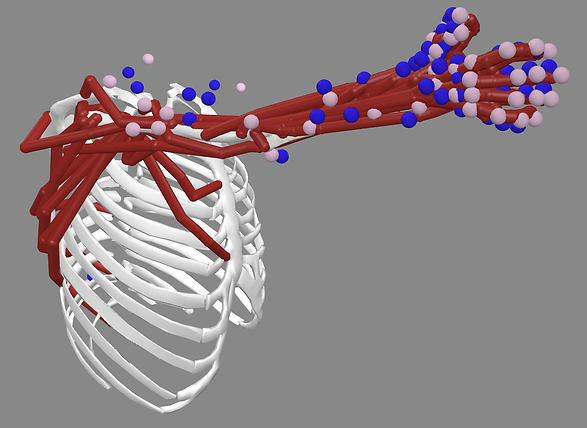
To study this, we collect experimental motion capture data (blue markers in the image on the right) and compare it to virtual markers (pink markers) generated from a generic computer model. The challenge is that no two hands are exactly the same, especially in our study population, which includes many participants over 40, where age-related changes can mean smaller or altered hand structures. Using a one size fits all model often leads to inaccuracies.
My project aims to bridge that gap by testing four different measurement sets, each using a different scaling approach. The least specific model applies the same scale factor to the entire limb, adjusting all segments equally. The next level increases specificity by allowing certain regions, such as the forearm and hand, to be scaled differently, accounting for situations where one area may be proportionally larger or smaller than expected. A third model separates the thumb’s scale factor from the rest of the fingers, enabling a more focused study of CMC OA. The most detailed model applies unique scale factors to very small components, such as the proximal, middle, and distal segments of each finger, for maximum anatomical precision. By comparing these approaches, I aim to determine how scaling detail impacts biomechanical analyses, particularly in improving calculations of joint angles and interpretations of muscle forces and torques during real world tasks.
Project Responsibilities

As part of my project, I help run trials by collecting motion capture data, ultrasound images of the hand and forearm, and survey responses about participants’ pain levels. After collecting the data, I use Vicon software to perform gap filling, which means identifying and reconstructing sections of the recording where markers were temporarily not detected, such as when a participant’s hand moves out of the cameras’ line of sight or a marker is briefly blocked. This step ensures the dataset is continuous and complete. Once the recordings are repaired, I create customized computer models for each participant by adjusting the scale of the model from the entire arm down to specific areas like the forearm, palm, thumb, and fingers so it better matches their anatomy. These personalized models are then analyzed in OpenSim, where I calculate joint angles and study the forces and torques involved in different movements.